Numero Uno in the Great American Songbook? Surely in contention are these 1946 lyrics by Irving Berlin, as performed by Fred Astaire in the Hollywood movie, Blue Skies:
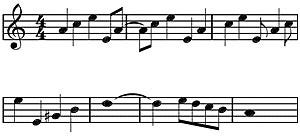
Different types who wear a day
Coat pants with stripes and cutaway
Coat perfect fits, puttin’ on the Ritz
Dressed up like a million-dollar trooper
Tryin’ hard to look like Gary Cooper
(Super duper)
Come let’s mix where Rock-a-fellas
Walk with sticks or umbrellas
In their mitts, puttin’ on the Ritz
Have you seen the well-to-do,
up and down Park Avenue
On that famous thoroughfare
with their noses in the air
High hats and arrow collars,
white spats and lots of dollars
Spending every dime
for a wonderful time
Spangled gowns upon a beauty
Of hand-me-downs, on clown and cutie
All misfits
Puttin’ on the Ritz
Strolling up the avenue so happy
All dressed up just like an English chappie
Very snappy!
You’ll declare it’s simply topping
To be there, and hear them swapping
Smart tidbits
Puttin’ on the Ritz
(Move, move, gotta dance, gotta dance)
If you’re blue and you don’t know
Where to go to, why don’t you go?
Where fashion sits, puttin’ on the Ritz
Puttin’ on the Ritz, puttin’ on the Ritz
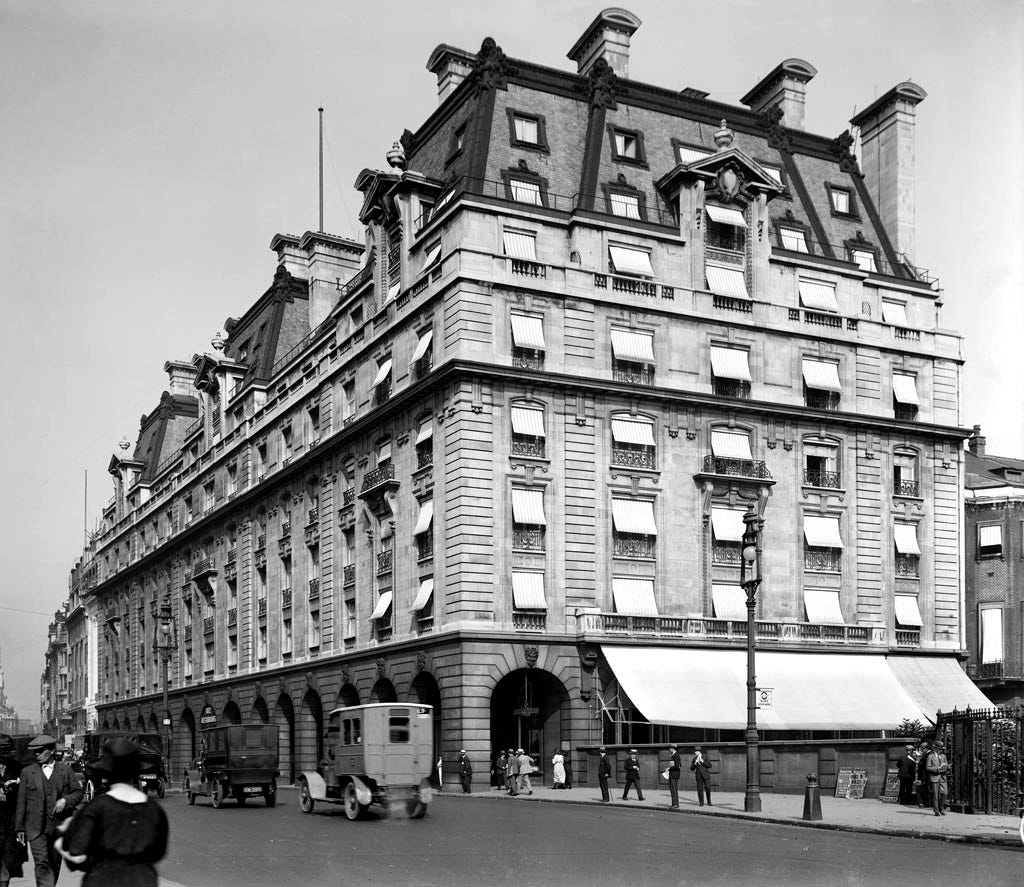
But do you know the other set of lyrics, the original 1927 version? First introduced in a 1930 Hollywood musical starring Harry Richman, a then-famous nightclub performer, with an interracial (but separate) chorus of more than two dozen clapping, toe-tapping, thigh-slapping dancers in top hats and striped pants:
Up on Lenox Avenue?
On that famous thoroughfare,
With their noses in the air?
High hats and colored collars,
White spats and fifteen dollars.
Spending every dime
For a wonderful time.
If you’re blue and you don’t know where to go to,
Why don’t you go where Harlem flits?
Puttin’ on the Ritz.
Spangled gowns upon a bevy of high browns
From down the levee, all misfits,
Puttin’ on the Ritz.
That’s where each and every lulu-belle* goes
Ev’ry Thursday evening** with her swell beaus,
Rubbing elbows.
Come with me and we’ll attend their jubilee,
And see them spend their last two bits.
Puttin’ on the Ritz.
* A generic nickname for a black maid.
** Typically, the maid’s night off.
CODA
Going down, deeper still. Second floor. Ding, ding. The ground floor, ding, ding. And now the basement. Like the elevator at Bloomingdale’s. Outerwear. Innerwear. Underwear. Or like the layers of Troy, each layer buried by the one above, and forgotten. I found this version online:
Spangled gowns upon the bevy of high browns
From down the levy, all misfits,
Puttin’ on the Ritz
But with levy spelled like bevy, instead of levee.
Levy. A Jew.
Israel Isidore Beilin is his real name, from the shtetls of Russia where he was born in 1888.
He’s from “down the Levy” – not just from Russia, but a spiritual descendant of the original Levites, one of the twelve tribes of Israel who wandered the Egyptian desert in the time of Moses.
Levites had a special role in that nomadic culture. They were assistants to the priests, and were charged with responsibility for taking down the tabernacle, the tent of holy worship, and setting it up again wherever the tribes went. So a Levy is someone who must re-establish the link with the past, whenever there is a migration to a new land.
But this Levy has broken with the past. His father was a cantor in a Russian synagogue, but Izzy becomes a singing waiter in a restaurant in Chinatown (below a whorehouse), entertaining customers even on the Sabbath.
The name of the establishment? Nigger Mike’s. I kid you not. (But Mike was really a Russian Jew.) Izzy soon changes his name from Beilin to Berlin. Extending his ethnic reach, his first royalties (37 cents) are for a song about an Italian immigrant girl. After he becomes famous, he continues his rise, marrying a Catholic girl from a wealthy family, but over the strenuous objections of Daddy.
So Izzy’s a misfit in the Gentile white world, and just like the “high browns” – the light-skinned black women of his song – he too is “passing.” Just puttin’ on the Ritz. Each step another step further away, burning his past.
And he even confesses to it, right there in the original lyrics! During an instrumental break between stanzas, Berlin inserts an aside, in parentheses:
(Boys, look at dat man puttin’ on that Ritz)
(You look at him, I can’t)
Why can’t Berlin look at him? First of all, it’s a joke, because it’s not possible to look at yourself while you dance – “that man” is him! And second, no joke, because he can’t bear to look at himself – he’s too ashamed – passing himself off as a Gentile, an insider, having disowned and discarded the lower-class immigrant heritage of his father, and his father’s fathers.
Perhaps the shame goes even deeper. After all, he’s not just gaining entrée to the dominant Christian culture, he’s doing it by appropriating another culture – the black idiom of “ragtime,” which is just an early term for jazz, with it’s syncopated “ragged” meters.
He’s used it to jazz up his own songs, in order to make a career for himself, beginning with his first big hit in 1911, Alexander’s Ragtime Band. And one of Berlin’s earliest dreams was to expand it into a “syncopated opera” – a jazz show for Broadway.
And who is this Alexander? Apparently a real man by the name of Alexander Joseph “King” Watzke, a jazz violinist who had a popular New Orleans band. Another white guy whose ancestors emigrated from Europe.
So here’s Izzy, getting a pass out of the ghetto by imitating another white guy who became a success by imitating black music, and then in 1927, Izzy fesses up in a song about black people strutting their stuff on Lenox Avenue, imitating rich white folks while they are being gawked at by “real” white folks who’ve come up to Harlem, slumming with their girl friends, for an evening of… fun.
Does Izzy make you dizzy? Round and round it goes. Al Jolson, blacking up, singing on the stage about his dear old Mammy. Real mammies, all dolled up, dancing in the street, blacking down, pretending their mammies aren’t. A Möbius strip with lots of half-twists, all shading into a dusky, ambiguous gray.
But Izzy put it all quite succinctly, in another song about ritzy Park Avenue, nine years before he rewrote Puttin’ on the Ritz in 1946, turning the very notion of slumming on its head:
Come on, there’s lots of fun in store for you
See how the other half lives on Park Avenue
Let’s go slumming, take me slumming
Let us hide behind a pair of fancy glasses
And make faces when a member of the classes… passes
God Bless America the Beautiful, where everyone is passing, for someone else. Endlessly re-inventing themselves, one identity molting into another. Try one on for size. And if you aspire even higher, to movie-star status, like Mr. Cooper, then you are a Super duper. Make believe. There’s no business like show business.
Does anyone else know about all of this? I don’t know.
Well, you do. I’m passing it on, so you too can look and make a face. In the mirror. Who is dat?
ps. And yet one more layer, this one above all the others. The one I began with, after a friend sent me a link to a rather strange video. A “flash mob” had gathered outdoors to celebrate a Russian wedding by breaking out into a rousing rendition of the Berlin song, the official Park Avenue version. But the video was way too slick for a spontaneous outbreak of song and dance. It even had aerial shots from a helicopter. Turns out it was trying to pass for something else – only pretending to be a real wedding, while in reality it was just a very fancy campaign ad. Putin on the Ritz.
Thanks for reading The History Nobody Knows!
 The History Nobody Knows
Leave a comment