Where is it?
Once upon a time, in 1662, to be more specific, it was located in the pineal gland, a small pea-sized bit of matter that sits in the mid-brain. It’s unique among all the other structures of the brain, in that it’s unique. There is only one pineal gland, whereas there are two of just about everything else, one for the left side and the other on the right.
Because of its central location, René Descartes called it the “principal seat of the soul,” the point of connection between mind and body. According to René, a person can’t ever have “more than one thought at a time,” so something has to decide the order in which the brain decides what to decide. And the most likely suspect, in his view, was the tiny soulful homunculus dwelling at the center of it all, a sort of inner third eye, conducting the orchestra, directing all the traffic, in “the most suitable possible place for this purpose,” the pineal.
The pineal has long since lost its privileged position as the brain’s maestro, and indeed the very idea of a central coordinator has been replaced by the notion of “emergence,” the “process whereby larger entities, patterns, and regularities [e. g. Life itself] arise through interactions among smaller or simpler entities that themselves do not exhibit such properties.” (Huh?)
But despite these newly emergent “properties,” they’re all arising on the same old property, the good old noggin, just writ a little larger. Instead of it taking place in a tiny pea at the center of it all, now all of it is supposed to happen all over the place, but still in the same space, inside the skull, and still at the center.
Once upon a time, the center of the world was the Medi-terranean – literally, the very middle of the Earth. With the omphalos, its navel, in Greece. Gradually it moved West, and the center was now somewhere in Europe, and then this guy from Poland, a sort of satellite state, went to the center of it all, to study in sunny Italy, but when he returned home, Copernicus proceeded to show everyone that we weren’t at the center of it all after all, but were just a satellite revolving around the Sun. (Boo!)
Then Darwin shocked everyone with the notion that We aren’t even the center of the biological universe but are only one of a vast number of species, all evolving together. And in the last century, Europe itself has lost its own privileged position as the pineal gland of world culture, and everything European is now looked down upon merely as “Eurocentric.” And even the Sun at our own center has now shrunk to only one of trillions, adrift in an incommensurably vast sea of many billions of galaxies. The Incredible Shrinking Us.
Where can all of this be heading? And when will it all finally end, this centro-cephalic vision that somehow there MUST be a Center Somewhere within the Head?
Then an article appeared in The NY Times by a philosopher (Alva Noë), challenging the neuroscientists. Maybe they have got it all wrong in their search for the center of human nature, mistakenly attempting to decipher it in the chemically coded interactions within the brain. Maybe they’ve got it ass-backwards, or at least mind-backwards, and maybe a better place to look would be Art. The product of the brain, and perhaps its most majestic manifestation.
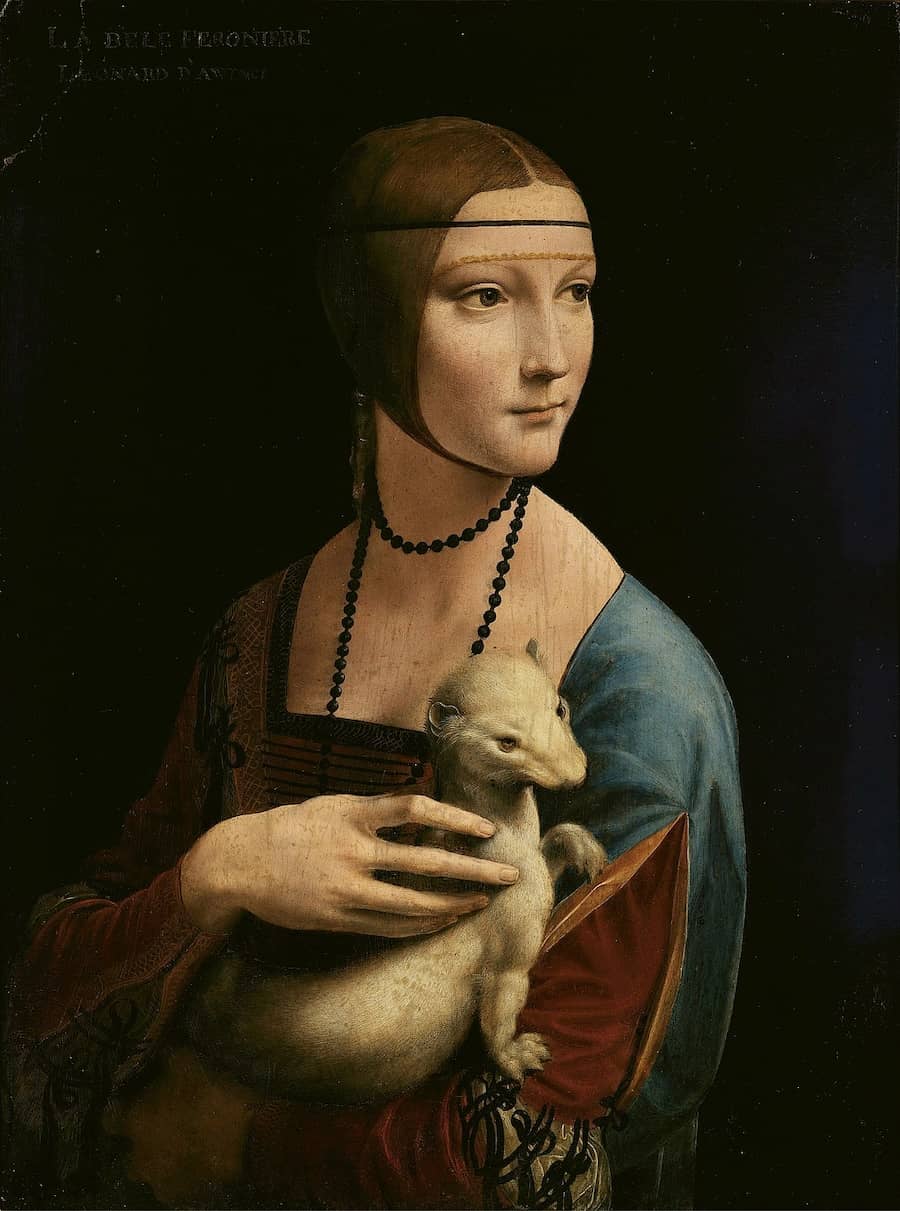
So the gentleman proceeds to take a look inside, and as a more specific example, he chooses a painting. And not just any old painting, but an iconic work of Beauty, Leonardo’s Young Lady with an Ermine, a portrait of his patron, the Duke of Milan’s newly acquired 16-year-old mistress, Cecilia Gallerani.
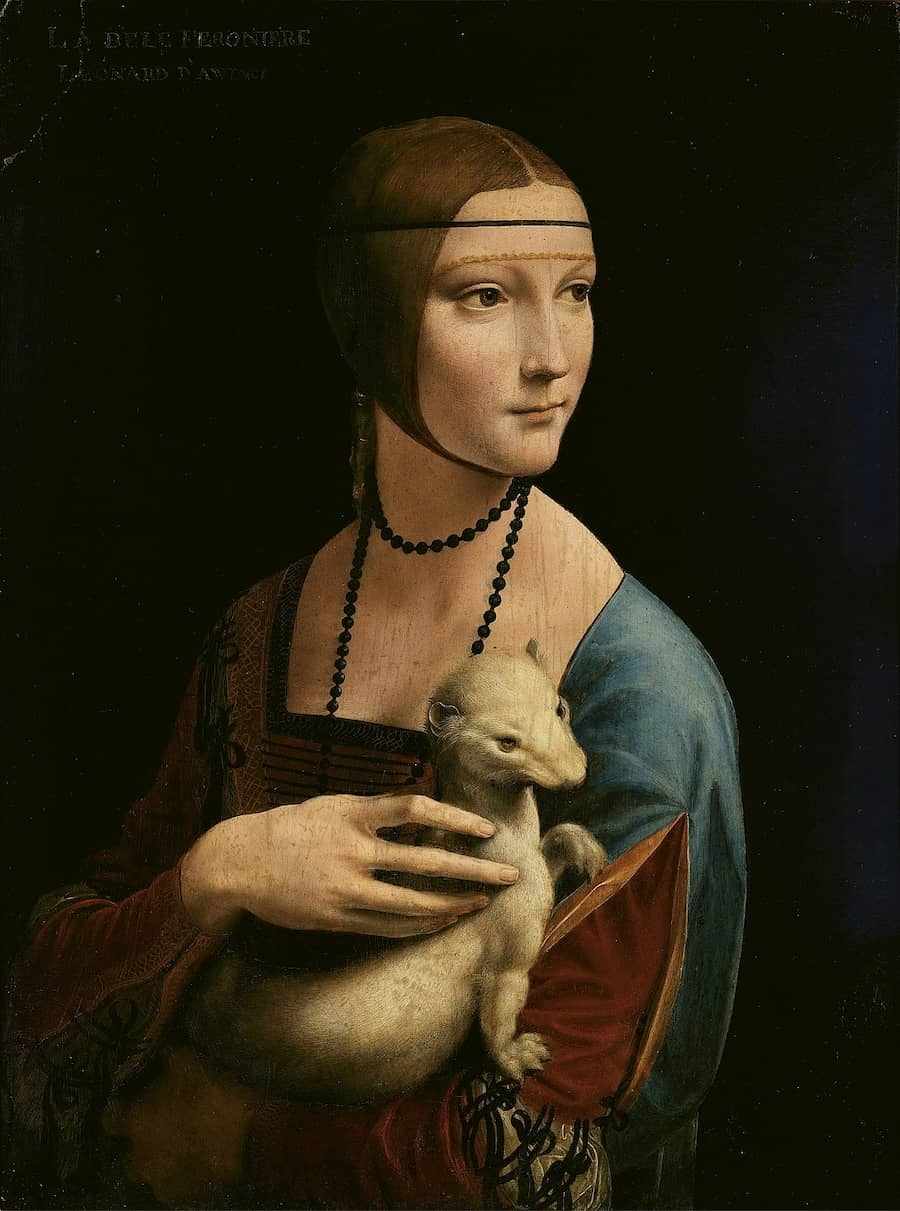
Like any wealthy buyer, especially a collector of women, always seeking to upgrade his status, Signor Sforza apparently wished to show off his new plaything, as a matter of pride, and no doubt to excite the envy of his peers and underlings. And more than just a beauty, she was known far and wide for her scholarship and her fine poetry. Quite a catch.
But now the writer attempts another catch, within the confines of the frame, as though that, and not the brain’s neurochemistry, is where he’ll finally find the elusive Heart of Human Nature. But all he sees, and deems worthy of notice is… “her jarringly oversized and masculine hand.”
Really?!
Well, he does have a point. The hand is weird – the fingers incredibly elongated, and indeed, the whole paw looks as though it were alive and had an independent life separate from its owner. So what are we to make of this? Are we to assume Leonardo somehow botched the hand-job, that although he’d spent countless hours studying medical corpses, male and female, meticulously drawing their anatomy, he could never get this particular hand quite right?
But though the writer wonders “why Leonardo draws our attention to that feature of this otherwise beautiful young person,” all he will venture to say about it is that “Art disrupts plain looking and it does so on purpose. By doing so it discloses just what plain looking conceals.” But dammit, man, what precisely is being concealed here? And what is being disclosed? And to what purpose? If you know something we don’t, why not just tell us?
So I will ask again. And even suggest a few answers.
First: perhaps the unusual size of the hand is meant to draw attention to what is behind it – to the pure white ermine, more commonly known to us as a weasel.
It’s quite something all on its own, clinging to her arm, so fantastic it almost puts the enormous hand to shame. In fact, the ermine isn’t really there, its presence only symbolic – in Renaissance iconography it stands for Purity and Moderation. (You don’t have to be an art historian to know that – a few googles will suffice.)
But this pristine symbol is especially odd in this instance, since the young lady in question became Il Duce’s mistress only after she was engaged to be married to someone else, who threw her over for another woman. So she is twice spoiled! And like her ermine, she too has a beautiful furry pelt, underneath it all, not anywhere near her brain, coveted perhaps by the hand of a man, pawed at by her owner.
So perhaps the hand and the ermine need to be viewed together, metaphorically, as a single complex and deliberately ambiguous symbol, the pure and the impure mixed, intertwined in an uneasy embrace.
And while the painter draws our attention to this puzzling imagery, her attention, and also the ermine’s, is drawn elsewhere, to someone outside the frame, to the right. (Perhaps her patron? who has just paid a surprise visit to Leonardo’s studio to see how the portrait is coming along… )
It’s quite a moment, this shift in attention. And to make sure we notice it, Leonardo has painted her body facing three-quarters to the right! (Her left.) As though he wanted to capture her implied movement – she has only just now turned her head in the other direction, toward something unseen. And she has this little smile on her lips. So what is she thinking?
(My own guess: “He thinks he owns me, like I was his… pet.” Ok, what’s yours?)
So instead of letting us focus our gaze on her face, looking simply and directly at a portrait of a stunningly beautiful woman, we are drawn away, not just in one direction, but in two, towards the ermine-in-hand, and out of the frame entirely, creating a subtle, but disturbing sense of mis-direction, or perhaps re-direction of our attention to everything in the painting that is hidden, and not shown.
Is it that Beauty is only skin-deep? Or is Leonardo perhaps suggesting to the viewer that there is much more going on here than mere beauty? And perhaps in all Art, that Beauty is only the first of many layers. (And does not that other mysterious smile, the more famous by far, hint at this too?)
And who knows, maybe what is taking place in front of us isn’t taking place out there at all, in the picture, or even beyond the confines of the frame. As Freud was at pains to point out, everything we know about Leonardo’s personal history points to the central fact of his homosexuality. So perhaps that is the reason, or part of the reason, for the ambivalent take on feminine beauty (one of only four women he ever painted).
In which case, at least part of what is going on here is taking place outside the frame of Consciousness itself.
So hiding behind that big fat hand are a multitude of meanings and secrets, social and sexual, perhaps intended, but perhaps not. If we look for them, what do we find? Human nature? Or perhaps even the soul? Yes, but where?
Everywhere and nowhere.
Like everything in the cosmos.
At the center of it all, one vast enigma.
* * *
Thanks for reading The History Nobody Knows!
 The History Nobody Knows
Leave a comment