• I gotta tell you about Edd. One of the nicest & most unusual guys I (or you) will ever meet, and it was only yesterday that I actually met him.

    I had decided it was finally time to take care of my final business. On Earth. So I just walked into the MacArthur Funeral Home on Main Street — the only such facility in the town in upstate New York where I live — and plunked myself down on [in] one of those super-comfy armchairs they have in such establishments, next to the table with the bowl of mints and the Kleenex box.

    And soon Edd appeared. Tall and lanky and dressed impeccably in a dark suit, and sporting one of those little comb mustaches that make you look older and more dignified than you really are. “What can I do for you, Sir.”

    “I hope I’ve got it right: a ‘pre-funded, pre-need funeral agreement’.” Which I need.

    “Yep, that’s it. You’ve come to the right place. Just step into my office and have a seat.”

    And while he’s filling out the forms, I ask Ed (not knowing it’s actually “Edd” — a Polish nickname for… Eddiuz?) how long he’s been “working here.”

    To which he replies, coolly, “Well, actually… I don’t. Work here.”

    Huh? “But then why are you selling me a product from a company you don’t… actually work for? Are you some kind of scam-artist?”

    “Nope, just filling in for Paul. The guy hasn’t had a day off in the last 5 years. It’s a supply & demand sort of situation.” And Death takes no holidays.

    So here I must digress: Back about 1957, there was this TV show, a Western about a guy named “Paladin” (a medieval knight), played by this craggy-faced actor (Richard Boone), with a much better mustache than Edd’s.
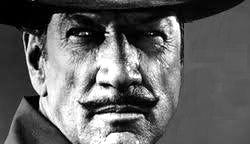
    Who had this calling card:
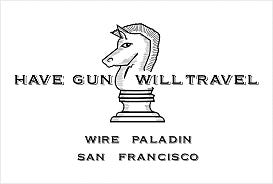
    So that’s what Edd is — an itinerant funeral director. Have Hearse — Will Travel.

    Slinging bodies instead of guns. Which he does, from his home in (even more rural) Madison County, about an hour north of here, to over a dozen funeral establishments, when the number of dead bodies (especially up here in flu season) exceeds the stamina of the resident director, and he calls Edd up and hires his services for a few days.

    And just in case you’re wondering if he actually has a hearse, he does. But it isn’t brand-new, though Edd set up shop only a year ago. No, this hearse already had… 8000 miles on it. What? A used hearse with only 8000 miles on it?

    Edd explained. The funeral director he bought it from lived in a small town. And the place where they kept all the stiffs was right next door, only a hundred yards away. So a round-trip was just 200 yards. Edd gave me a wink.

    But still, do the math: 8000 x 1760 / 200 = 70,000 dead people, give or take a couple of thousand. That puts a completely different spin on it. As in spinning in… Or making your head spin… Which makes you wonder just how many of these folks actually died a natural death. Maybe John Gotti or Vinnie (The Chin) Gigante were neighbors? Who knows? And I’m not even going to ask Edd.

    But one thing I’m betting I do know. That you’ve never thought about any of this in quite the way you are now.

    And while you’re at it, here’s a helpful tip I got from Edd. About burial urns. As I asked Edd about how I was going to get from the crematorium (I’m a Buddhist, so it goes without saying, though I just said it) to my final destination. Until my next stop – aka “incarnation” – perhaps as a dog (I’m quite ok with that) or a tree.

    “A burial urn? Those can get pretty expensive. Some people pay more than a thousand bucks. Why do you need a burial urn if you’re having yourself cremated? If I may ask?”

    And when I ask what the alternative was, Edd patiently explained that “I” (my “cremains,” as they call them in the biz) will come “pre-packaged.”

    And he reaches behind and pulls out a sample. A shiny black plastic cube, about 9 or 10 inches per side. Which he opens and from which he pulls a clear Ziploc baggie. “Actually, you’ll be in here.”

    And if I want, I can stay in there. As long as I like, or if I’d rather be scattered somewhere, by my loved ones, then all they’ll have to do is open the bag just a little, and start pouring. I just hope it’s a windy day.

    I feel so much better now. No kidding. My mind is at rest, knowing about the rest of me. How about you?

    And one last thing. I’ve read that everyone on Earth probably has a few atoms in their body that were once in Jesus. Or the Buddha. Or…
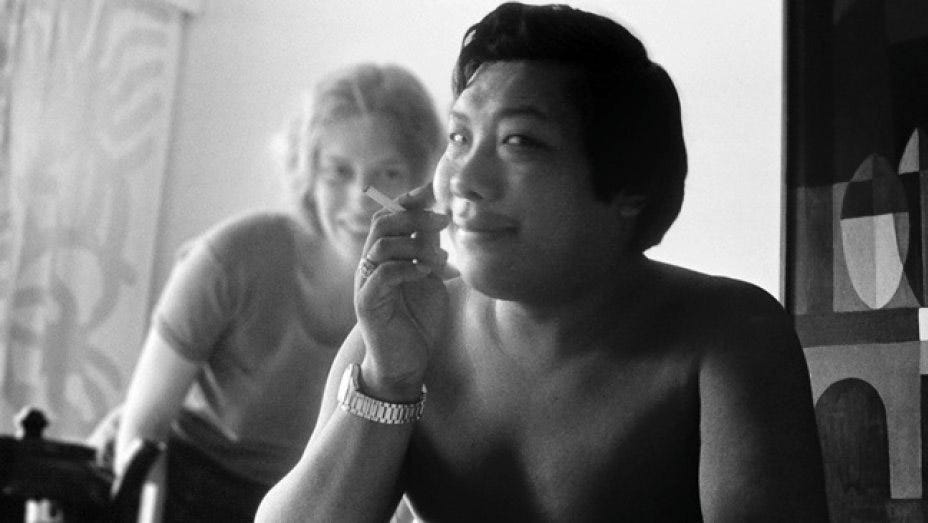
  • I live in a small town in upstate New York – 54 square miles in Delaware County, with a population of only about 1500 people.

    And yet there is not one, but two thriving Tibetan Buddhist contemplative centers in my town. One of them belongs to the Kagyu lineage, the “mishap lineage,” as it’s sometimes called.

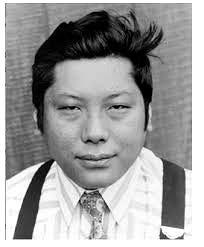
    At least my teacher, Chögyam Trungpa Rinpoche, called it that. (Some people have even called him a mishap too. A womanizer, an alcoholic, and worse.) That’s the lineage to which I’ve belonged, on and (now) off, for the last 4 decades. I’d no idea the center was here in my little town, until I passed by it one day in my car. Hiding there in plain sight. A bit of a shock. Just like Rinpoche.

    There are four major Tibetan schools or lineages. Besides the Kagyus are the Sakyas (both of them “Red hats”) and the Gelugpas (the Yellow hats). The guy who now heads the Gelugpa sect is called the Dalai Lama, and he’s the 14th reincarnation of the same “person,” dating back to the fifteenth century. My guy is called the Karmapa, and the current one is the 17th in an unbroken line going all the way back to 1100. At the age of 14, he escaped his Chinese captors, making his way across the Himalayas and arriving in India just as the new century began.

    The other retreat and practice center in my town belongs to the fourth Tibetan lineage, the Nyingmas. The Old Ones, who go back furthest of all. This is where Thinley Norbu Rinpoche had his headquarters. (His father used to be the head of the Nyingmas. The Dalai Lama is the spiritual head of Tibet, but all four are considered on the same level, and all are addressed as His Holiness.)

    From time to time, after I moved up here from New York, I would pay a visit to Thinley Norbu’s center, usually to celebrate a puja (a ceremonial ritual), followed by a communal meal, over which Rinpoche – pronounced RIM-poh-CHAY – an honorific used for spiritual teachers of status, meaning “Precious Jewel” – would preside as a sort of Crazy Wisdom emcee. One by one, he’d introduce his students, making them get up and give some ridiculous impromptu performance, the more excruciating and embarrassing the better, as a kind of spiritual discipline, a rite of passage, a public letting-go of ego. Let yourself be a Fool. Mercifully, as I was only a guest, I was spared having to undergo the operation, administered without benefit of anesthesia.

    But I knew the deal as I’d met Thinley Norbu before, a good 20 years earlier, when I was living in the city, as though in some previous lifetime, and my life here in upstate New York was another life, a kind of karmic afterlife. He lived in a brownstone in Chelsea, owned by an American Buddhist student who had gone to Sarah Lawrence with my wife. One day, as Rinpoche had been told I worked as a documentary film editor, I was invited over and asked if I would do him a favor and edit some of his videotapes.

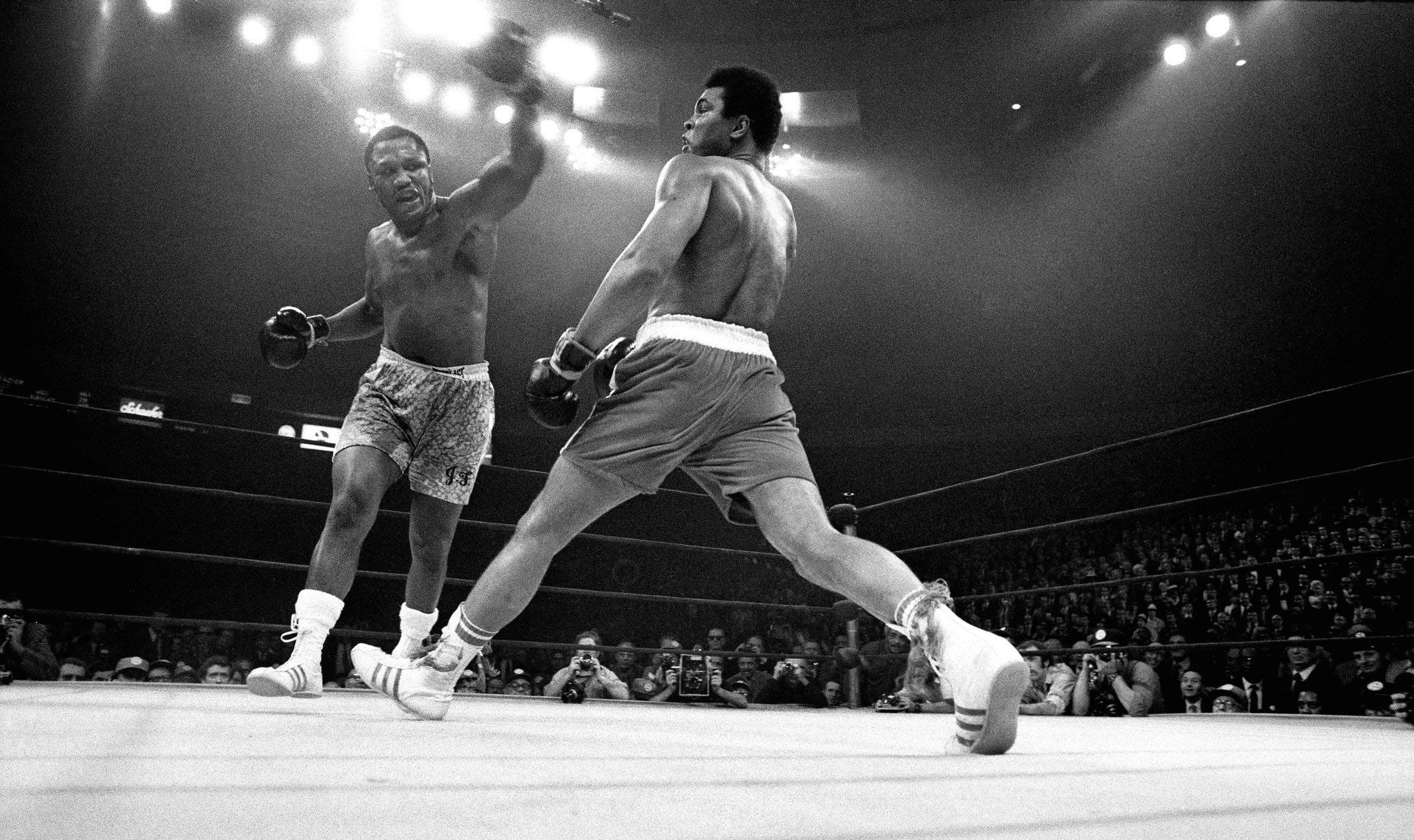
    At first I thought he wanted me to edit some of his talks to his students. But no, these were his boxing tapes. Yes, Rinpoche was a fan of American boxing, indeed, an aficionado. He had several cartons full of these, all carefully labeled as to who had fought and when. And he wanted me to go through them and re-record small sections, a round or two, from his favorites, what today you might call a playlist. From time to time, he’d come back into the room to check my progress, as I slowly rolled and re-rolled each tape back up to its starting point, a small-time Sisyphus. It took more than a few visits to complete the task.

    One time I was with Rinpoche and we had come to one of Mohammad Ali’s title fights. I turned to him and repeated the famous mantra: Float like a butterfly, sting like a bee. And I grinned.

    Rinpoche scowled. He was furious. “All wrong!”

    Then he stood up very slowly. And assumed the pose of a boxer, cocking his left fist in front of his face, his right fist held lower and closer to his body. Both feet flat on the ground, left foot forward. Like a rock. “You stand here. You look opponent in the eye. You give punch. You take punch. No butterfly. No bee.

    No tricks!”

    I’m still working on that one, even now, after all these years. Trying not to pull my punches. Letting myself look like a Compleat Fool. Think it’s easy? Have you tried it?

    Thanks for reading The History Nobody Knows!

    Share

  • Numero Uno in the Great American Songbook? Surely in contention are these 1946 lyrics by Irving Berlin, as performed by Fred Astaire in the Hollywood movie, Blue Skies:

    If you’re blue and you don’t know where to go, why don’t you go where fashion sits, Puttin’ on the Ritz
    Different types who wear a day
    Coat pants with stripes and cutaway
    Coat perfect fits, puttin’ on the Ritz
    Dressed up like a million-dollar trooper
    Tryin’ hard to look like Gary Cooper
    (Super duper)
    Come let’s mix where Rock-a-fellas
    Walk with sticks or umbrellas
    In their mitts, puttin’ on the Ritz

    Have you seen the well-to-do,
    up and down Park Avenue
    On that famous thoroughfare
    with their noses in the air
    High hats and arrow collars,
    white spats and lots of dollars
    Spending every dime
    for a wonderful time
    Spangled gowns upon a beauty
    Of hand-me-downs, on clown and cutie
    All misfits
    Puttin’ on the Ritz

    Strolling up the avenue so happy
    All dressed up just like an English chappie
    Very snappy!
    You’ll declare it’s simply topping
    To be there, and hear them swapping
    Smart tidbits
    Puttin’ on the Ritz
    (Move, move, gotta dance, gotta dance)
    If you’re blue and you don’t know
    Where to go to, why don’t you go?
    Where fashion sits, puttin’ on the Ritz
    Puttin’ on the Ritz, puttin’ on the Ritz
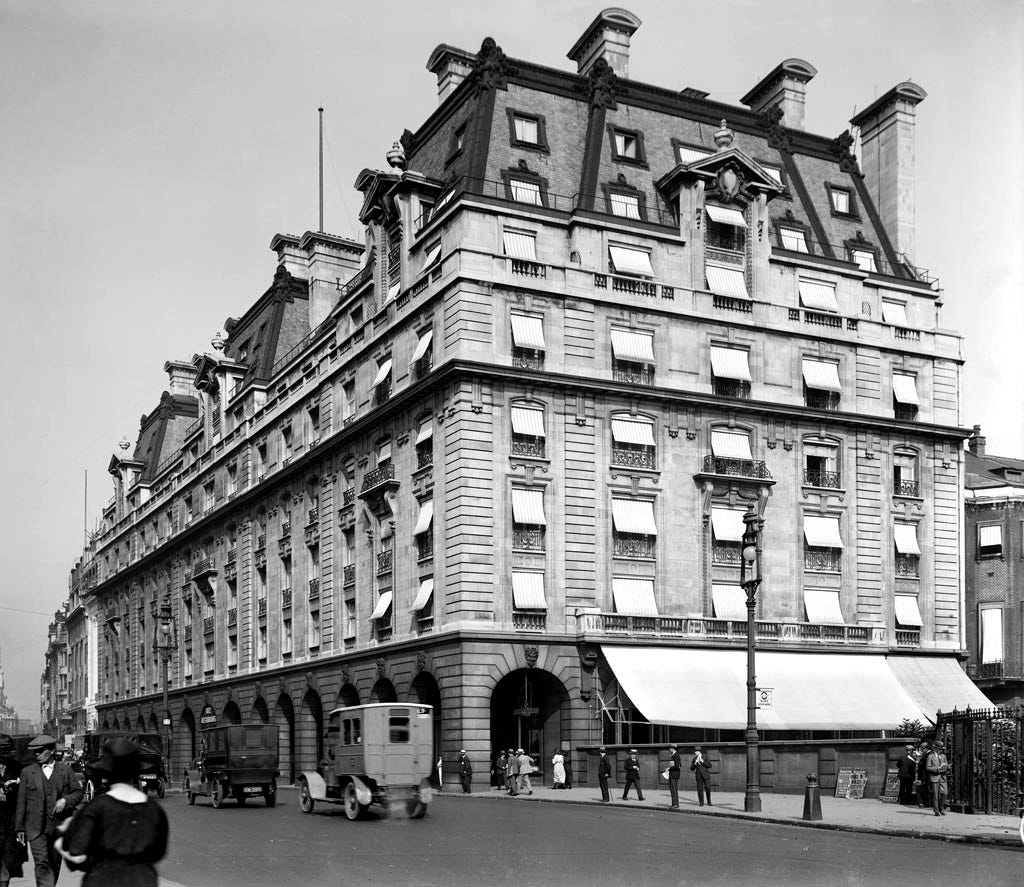
    The Ritz Hotel, London

    But do you know the other set of lyrics, the original 1927 version? First introduced in a 1930 Hollywood musical starring Harry Richman, a then-famous nightclub performer, with an interracial (but separate) chorus of more than two dozen clapping, toe-tapping, thigh-slapping dancers in top hats and striped pants:

    Up on Lenox Avenue?
    On that famous thoroughfare,
    With their noses in the air?
    High hats and colored collars,
    White spats and fifteen dollars.
    Spending every dime
    For a wonderful time.
    If you’re blue and you don’t know where to go to,
    Why don’t you go where Harlem flits?
    Puttin’ on the Ritz.
    Spangled gowns upon a bevy of high browns
    From down the levee, all misfits,
    Puttin’ on the Ritz.
    That’s where each and every lulu-belle* goes
    Ev’ry Thursday evening** with her swell beaus,
    Rubbing elbows.
    Come with me and we’ll attend their jubilee,
    And see them spend their last two bits.
    Puttin’ on the Ritz.
    * A generic nickname for a black maid.
    ** Typically, the maid’s night off.


    CODA

    Going down, deeper still. Second floor. Ding, ding. The ground floor, ding, ding. And now the basement. Like the elevator at Bloomingdale’s. Outerwear. Innerwear. Underwear. Or like the layers of Troy, each layer buried by the one above, and forgotten. I found this version online:

    Spangled gowns upon the bevy of high browns
    From down the levy, all misfits,
    Puttin’ on the Ritz

    But with levy spelled like bevy, instead of levee.

    Levy. A Jew.

    Israel Isidore Beilin is his real name, from the shtetls of Russia where he was born in 1888.

    He’s from “down the Levy” – not just from Russia, but a spiritual descendant of the original Levites, one of the twelve tribes of Israel who wandered the Egyptian desert in the time of Moses.

    Levites had a special role in that nomadic culture. They were assistants to the priests, and were charged with responsibility for taking down the tabernacle, the tent of holy worship, and setting it up again wherever the tribes went. So a Levy is someone who must re-establish the link with the past, whenever there is a migration to a new land.

    But this Levy has broken with the past. His father was a cantor in a Russian synagogue, but Izzy becomes a singing waiter in a restaurant in Chinatown (below a whorehouse), entertaining customers even on the Sabbath.

    The name of the establishment? Nigger Mike’s. I kid you not. (But Mike was really a Russian Jew.) Izzy soon changes his name from Beilin to Berlin. Extending his ethnic reach, his first royalties (37 cents) are for a song about an Italian immigrant girl. After he becomes famous, he continues his rise, marrying a Catholic girl from a wealthy family, but over the strenuous objections of Daddy.

    So Izzy’s a misfit in the Gentile white world, and just like the “high browns” – the light-skinned black women of his song – he too is “passing.” Just puttin’ on the Ritz. Each step another step further away, burning his past.

    And he even confesses to it, right there in the original lyrics! During an instrumental break between stanzas, Berlin inserts an aside, in parentheses:

    (Boys, look at dat man puttin’ on that Ritz)
    (You look at him, I can’t)

    Why can’t Berlin look at him? First of all, it’s a joke, because it’s not possible to look at yourself while you dance – “that man” is him! And second, no joke, because he can’t bear to look at himself – he’s too ashamed – passing himself off as a Gentile, an insider, having disowned and discarded the lower-class immigrant heritage of his father, and his father’s fathers.

    Perhaps the shame goes even deeper. After all, he’s not just gaining entrée to the dominant Christian culture, he’s doing it by appropriating another culture – the black idiom of “ragtime,” which is just an early term for jazz, with it’s syncopated “ragged” meters.

    He’s used it to jazz up his own songs, in order to make a career for himself, beginning with his first big hit in 1911, Alexander’s Ragtime Band. And one of Berlin’s earliest dreams was to expand it into a “syncopated opera” – a jazz show for Broadway.

    And who is this Alexander? Apparently a real man by the name of Alexander Joseph “King” Watzke, a jazz violinist who had a popular New Orleans band. Another white guy whose ancestors emigrated from Europe.

    So here’s Izzy, getting a pass out of the ghetto by imitating another white guy who became a success by imitating black music, and then in 1927, Izzy fesses up in a song about black people strutting their stuff on Lenox Avenue, imitating rich white folks while they are being gawked at by “real” white folks who’ve come up to Harlem, slumming with their girl friends, for an evening of… fun.

    Does Izzy make you dizzy? Round and round it goes. Al Jolson, blacking up, singing on the stage about his dear old Mammy. Real mammies, all dolled up, dancing in the street, blacking down, pretending their mammies aren’t. A Möbius strip with lots of half-twists, all shading into a dusky, ambiguous gray.

    But Izzy put it all quite succinctly, in another song about ritzy Park Avenue, nine years before he rewrote Puttin’ on the Ritz in 1946, turning the very notion of slumming on its head:

    Come on, there’s lots of fun in store for you
    See how the other half lives on Park Avenue
    Let’s go slumming, take me slumming
    Let us hide behind a pair of fancy glasses
    And make faces when a member of the classes… passes

    God Bless America the Beautiful, where everyone is passing, for someone else. Endlessly re-inventing themselves, one identity molting into another. Try one on for size. And if you aspire even higher, to movie-star status, like Mr. Cooper, then you are a Super duper. Make believe. There’s no business like show business.

    Does anyone else know about all of this? I don’t know.

    Well, you do. I’m passing it on, so you too can look and make a face. In the mirror. Who is dat?

    ps. And yet one more layer, this one above all the others. The one I began with, after a friend sent me a link to a rather strange video. A “flash mob” had gathered outdoors to celebrate a Russian wedding by breaking out into a rousing rendition of the Berlin song, the official Park Avenue version. But the video was way too slick for a spontaneous outbreak of song and dance. It even had aerial shots from a helicopter. Turns out it was trying to pass for something else – only pretending to be a real wedding, while in reality it was just a very fancy campaign ad. Putin on the Ritz.

    Thanks for reading The History Nobody Knows!

  • File Settings

    Done

    Title

    Description

    Thumbnail

    Will be cropped to a 3:2 aspect ratioUpload

    Draft

    My teacher liked to dress up in a variety of different costumes, some of them seemingly quite comical, but which he took very seriously. For instance, the kilts he liked to walk around in, as he had begun his career as a guru-fraudster (as many people saw him) in the first Buddhist monastery in Europe, in, you guessed it, Scotland. But this costume, the one in my story, was a uniform. A military outfit, with a full set of rather fake-looking medals plastered across his chest. And with epaulets, those ornamental fringed shoulder pads worn as an insignia of rank. Only these epaulets were different. They were… enormous, and stuck out past the end of Rinpoche’s shoulders, jutting out into space, as it were.

    But of course, no one dared to ask him about it. Until one day, at the end of one of his “dharma talks,” when Rinpoche did as he always did, and opened the floor for questions and discussion, a guy at the back raised his hand. “Yes, sir,” Rinpoche asked, “what is it?” And the guy said, “Ummm, your uniform.” “Yes, what about my uniform?” “Can you tell us why those… epaulets are so… big?” “Epaulets?” “Yes, your shoulder pads.” “Those are not epaulets.” . . . . “Then, sir, what are they?”

    “They are landing pads.” “Landing pads?” “Yes, for the dralas. And I would like you very much to meet them.”

    But Rinpoche is no longer here, at least not on this plane, and as there doesn’t appear to be anyone else around who seems willing to step forward to do the honors, I’ll try and introduce you to them as best I can.

    Dralas are spirits. Well, maybe not quite. Let’s just say they are… entities. Of some kind or another. And in fact, there are a bunch of kinds. You have your basic garden-variety drala, a sort of protector spirit, a guardian, who lives in an area in the middle of your chest, like an invisible breastplate or shield.

    But dralas are everywhere, in trees and rivers, and even the dumbest of rocks.

    And you can tune into them any time you want, and experience things with an open heart, with curiosity and receptiveness, which is why they often reveal themselves in female form, as dakinis, like this leggy damsel, dancing in the sky.

    They provide a gateway into another world, but it’s the same one everyone and every creature inhabits, only in this world, everything looks different. How? One day, Rinpoche was sitting on the grass with one of his teachers, and leaned over and pointed up at a tree, and whispered something in his ear. And they both broke up in hysterical laughter. And someone came over and asked a monk what he had said. And the monk replied, Rinpoche said, “They call that a tree.”

    And then there are the mahakalas, the Wrathful Ones,

    though I’m not quite sure if they qualify strictly as a class of drala, but in any case, they come from the same place, wherever that is. The one you see here is stomping his right foot, in a typical stance, and under it is a guy with an elephant-size ego.

    And they are indeed Wrathful, but not angry. Anger is an expression of frustration and a refusal to accept things as they are (or things as it is, as Suzuki Roshi always liked to say). The Wrath of a mahakala is of a different kind — they don’t take BS from anyone, you, me, or especially A-holes like… [He Who Must Not Be Named or else]. And you better watch out, if you’re naughty and not nice, and violate the Dharma, and let your ego run rampant and act without compassion, they will stomp on you and make you cry. I know, from experience.

    But if you think dralas or mahakalas are somehow floating around somewhere in outer space, you’d be making a big mistake. As Rinpoche was very careful to make clear, over and over again, dralas are none other than a part of your own mind. Projections, if you will, but not in the same sense they are commonly understood in Western psychology, as projecting undesirable feelings or emotions onto someone else, and blaming them.

    Treat a drala in the right way, with proper respect, and even devotion, and maybe one of them will land on your shoulder, and whisper something in your inner ear, and if you pay attention to the message they bring, and take the hint, and act accordingly, in accord with things as it is, and not as you might want them to be, then they might just be willing to become… an ally. Your daimon perhaps, as the ancient Greeks understood it, for dralas are only the name that Tibetan Buddhists give them. Every culture has a different name for them, or many different ones.

    It seems that the only culture that doesn’t have its own name for them is, alas, our own. Our gurus, the witch doctors who sit at the feet of Big Pharma doling out candy to pacify those who can’t follow the rules of order, simply don’t believe they exist. But of course they do, and I’m writing about them here to acknowledge the debt I owe them, and which I will never be able to repay. Without their kindness and fierce wisdom, I’d never have taken the risk and tried to write about any of this.

  • This is a photo that appeared in a local paper in Delaware County, where I live. They’ve been holding the parade in the town of Andes for more than 40 years. And as the story goes on to say, the main event of this celebration was “a reenactment of the fatal shooting of Delaware County Under-sheriff Osman Steele, an event that was considered the catalyst for the “Anti-Rent” movement.”

    Yes. A parade led by the Sheriff’s Office that celebrates the murder of a sheriff. And there’s more. The Anti-Rent War began in 1839, and resulted in the abolition of the unjust feudal system that had tied a quarter of million tenant farmers in upstate New York to vast tracts of land owned by a few wealthy “patroons.” But the fatal shooting took place at a farm in Andes in 1845, at the very end of the conflict. So how can it be, as the local paper blithely asserts, that the event was considered “the catalyst”?

    You walk into the room with your pencil in your hand
    You see somebody naked and you say, “Who is that man?”
    You try so hard but you don’t understand
    Just what you will say when you get home
    Because something is happening here but you don’t know what it is
    Do you, Mr. Jones?

    As the lyric of Bob Dylan’s “Ballad of A Thin Man” puts it.

    It’s a song about a straight guy who goes into… a gay bar? – with a pencil in his hand, like a reporter – and they all have “pencils” in their hands too. But what he’s doing and what they are doing are completely different. He’s an outsider. And they are insiders.

    So step into my Time Machine and let me take you back to 1845 to the town of Andes. And go inside, into The Hunting Tavern. And there he is, Osman Steele, standing by the bar, downing his second brandy.

    It’s August 7th. He’s on his way to Moses Earle’s farm, to auction off some of Mr. Earle’s cattle, to collect the two-years’ back rent he owes. Osman knows there will be trouble. But he isn’t afraid. He turns to the other customers – all “up-renters” on the side of law and order – and says, as legend has it: “Lead cannot penetrate Steele.”

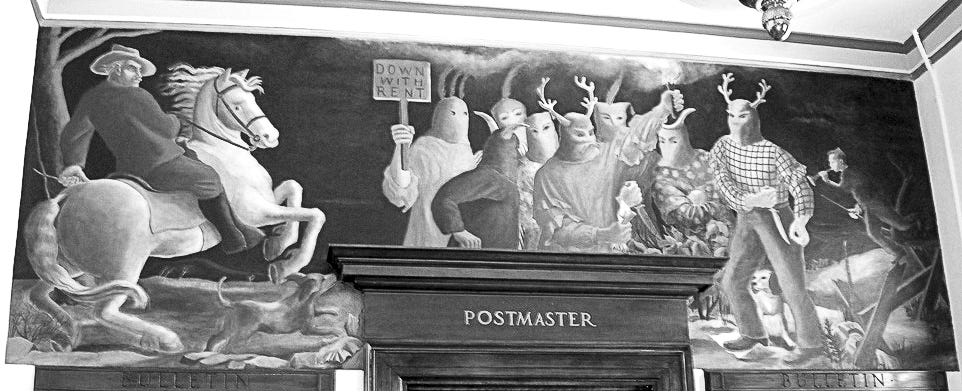
    When he arrives at the farm, he is met by more than 200 armed masked men. They are all dressed up in weird and menacing costumes – as portrayed in the mural at the local post office in Delhi, the County seat.

    They are doing their version of what they think the original inhabitants – who had their own lands appropriated by outsiders – looked like. Their outfits are woven together with strips of cotton, so they call themselves “Calico Indians.” They are mostly rowdy teenagers and young men in their early twenties. They are organized into “cells” with about a dozen individuals, each led by an older “Chief” – all with mock-Indian names like Red Jacket and Little Thunder. Jugs of whiskey are being passed down the line, to help them steady their own nerves.

    And there’s the Under-sheriff approaching them on his white horse. And there is the little boy on the right, tooting the tin dinner horn they used to call the local farmers to arms. But all you see are a couple of men drawing knives. There are no guns in sight.

    And if you ask the clerk behind the desk about it, he will hand you a postcard of the mural, and on the back it says: “The artist did not depict a specific event from the Down-Rent War, but sought to portray a typical meeting of the Calico Indians.” And what happened during these confrontations? If the Sheriff did not tear up his warrants, “he would be tarred and feathered.”

    So there you have it. The deep sense of pride in the role these men played in leading the fight against a terrible system of injustice. And the inability to accept what really took place that day. The coroner’s report, based on sworn testimony given the next day leaves no doubt: he was shot three times, and the fatal bullet entered his lower back. He was killed only after turning away from the mob.

    If you were at Moses Earle’s farm that day in 1845, you had to obey the Chief when he gave the order to fire. But at the same time, you knew you were taking a higher authority, the law of the land, into your own hands. After the Sheriff died, Earle Moses justified the murder on a still higher level, saying “The Almighty does not make mistakes.” The mob was only fulfilling the will of God.

    Those aren’t contradictions. They constitute what the anthropologist Gregory Bateson calls a double bind, a term he coined in the 1950’s to denote situations in which you cannot choose between two (or more) conflicting messages – because they occur on different levels of abstraction.

    They make you crazy. You are forever going back and forth between one level and another. The dilemma can’t be resolved. And soon you begin to make up things to alter the narrative so as to alleviate the pain.

    Is it any wonder that the local paper has reversed the order of events, and made the murder of the Sheriff the “catalyst” for the entire Anti-Rent War? If that’s what it took to get rid of the old feudal order, surely that was worth the life of one man.

    And since nobody knows whose bullet actually delivered the final blow, maybe it was just an accident and they were only aiming at his horse. You will hear that a lot from people who live in Andes. And the town’s own official website claims the Sheriff wasn’t even there – it was someone else – the “landowner” – who was murdered! Soon someone will be calling the mob “patriots.”

    On and on it has gone. Year after year. It has become a ritual. At every Community Day, the trauma is reenacted. And the parade is led by the Sheriff’s Office. Like love and marriage, they go together like a horse and carriage.

    But this isn’t just the story of Andes. It’s the story of America. Guns and freedom. Our national double bind.

  • When I was a teen, I loved to listen to Little Richard. We all did. I still do.

    And even back then, we all knew he was tutti fruity – the lyrics said so – and none of us thought he was referring to Italian ice cream or that he was just crazy about sex, like most of us were.

    The lyrics of the song were in a kind of code. So he could tell it like it really was and still be able to get up on stage, even on TV, and drive the audience into a screaming frenzy. Sort of like the way Liberace did, with all those rings and fur and candelabras. (Maybe grandma thought Mr. Showmanship just hadn’t met the right girl yet, and none of my family ever said he was a fagela – which is itself in code, as it’s an actual Yiddish word, literally “little birdie” – it was just something you didn’t talk about.)

    But Tutti Frutti wasn’t the only song of Little Richard’s – and a long line of others, especially Black song-writers, whose lyrics were stuffed with double entendres. Like Good Golly Miss Molly or Slippin’ and Slidin’ (Peepin’ ‘n hidin’) – and even today, at least one more has yet to come out of the closet. As it’s about being in the closet.

    Go look it up on the web. Only you won’t find it anywhere but here.

    Wikipedia repeats the same old story about the origins of the lyrics – Honey Chile, a popular DJ, introduced “a little girl” to Little Richard’s record producer “Bumps” Blackwell. She’d written a few lines of a song for Richard to record “so she could pay the treatment for her ailing aunt” – Saw Uncle John with long tall Sally / They saw Aunt Mary comin’ / So they ducked back in the alley.

    And the rest, as they say, is History, and after Little R recorded it in New Orleans on February 10, 1956, hundreds of groups, the Beatles and Elvis included, have done covers of it.

    The key is hiding there in plain sight, in the next-to-last stanza. Which repeats every word of the third stanza, except one.

    Sally is bald. Why? Because Sally’s a tall guy wearing a wig, and dressed in drag, and is working the street as a male prostitute. And “she’s” on the clock, and “built for speed” (doing as many “johns” as quickly as possible).

    And “Uncle” John is – well, duh – one of the johns, and has “the misery” (he’s pretending to Mary, his wife, that he’s straight – but John’s found a way to have his fun – with “Sally,” who is long (where it counts) and has the “thing” John needs (the original title of the song: “The Thing”).

    And when John sees Mary coming to find him, he ducks “back in the alley.” The Closet.

    But of course, maybe I’m just seeing “things” that aren’t really there. And if you want to go back to seeing it like everyone else, as a song a little girl wrote about her uncle so she could pay her aunt’s medical bill…

    Thanks for reading The History Nobody Knows!

  • Look more closely at just about anything, and the more closely you look, the more you see. The world is incredibly complex, and you don’t notice that until you really look.

    But sometimes things at first glance are so brutally simple you don’t see them at all.

    And then there’s this moment, this flash of lightning, and all of a sudden – ka-ching! – and then you see it, and everything suddenly looks different, in a new light.

    Say you’re walking on a street, could be anywhere in the USA, like this scene on a street corner in a small town in the middle of nowhere:

    Nowhere, in this case, being Morton, Mississippi, and that’s the Morton Bank you’re looking at, and this is the photo I found on Google Maps, taken only a few years ago.

    But take a ride on a Time Machine, all the way back to 1971, and now it’s an evening in early fall and everything in town is all closed up. And you don’t live in Morton, you’re a stranger, just passing through on your way home, back to Memphis.

    And you stop the car. And get out. And look across the street. And raise your camera and look through the viewfinder. Click. And now it looks like this:

    There it is again, in the greenish glare of the mercury street lamp. The Bank of Morton, the letters chiseled on the facade above the awning.

    Back then, when it was built in the late Twenties in the Art Deco style, with its massive volume and ornate geometrical design, it was an emblem of the future, a bright promise of luxury and glamour and Progress.

    A dinosaur spawned with countless others just before the meteor of the Great Depression struck. Now here it is again, more than 40 years later, a forlorn vestige, a ghost ship adrift in the vastness of space/time, a deserted street, a half-moon and a street-lamp sun set in a stunning purple glow. Planet Earth. Ka-ching.

    But today, it just looks like the first scene in this post. It could be any street, anywhere in the USA.

    The man from Memphis, who took the photo, is William Eggleston, aka Egg to his friends, and as of today, he’s still here on Planet Earth. But now, many people think he’s the best photographer in America. And that he revolutionized the medium, and brought color into photography in a way no one had ever done before.

    But I have a confession to make. When I first saw some of Egg’s work, back in 1976, at a one-man show at MoMA, I didn’t get it at all. Like a lot of people, I was upset. What we saw was an egregious violation of our Idea of the Art. Meaning rigorous black-and-white photography, the kind MoMA’s permanent collection is chock-full of. Walker Evans, Paul Strand, Steichen and especially the guy at the very top of the pyramid. Henri Cartier-Bresson.

    And those exquisite and elegant Decisive Moments. Everything in magical order within the frozen frame.

    In Egg’s photos, there are no such moments. Only a celebration of Banality. And a lot of vulgar Color. Ugh.

    And another confession. When Robert Frank’s The Americans first came out in 1959, there were any number of people who looked at them and saw only grainy b/w photos, some tilted at an angle, others out of focus. Photos of people you couldn’t even see, hidden (or hiding) behind masks and flags. Dark seedy motel rooms, people stuck in elevators, or staring back at the camera from a bus. What was that all about?

    I was among them. Another idiot seeing something so brutally simple that I didn’t see anything at all. But within ten years, people were not only seeing what was there, there were legions of photographers roaming the streets and highways of America, trying to find their own Robert Frank photos.

    And when that happened, was Robert Frank thrilled by all that recognition? No. He moved from New York to a tiny, desolate village on the western edge of Cape Breton Island, in Nova Scotia. And wrote a postcard to a friend. All it said was, “I’m famous. Now what?” And he never took another photo again that looked like a Robert Frank.

    And now Frank is gone, but like the Sondheim song about the formerly famous has it, Egg is still clocking in at 86 as I write this.

    I suppose it’s one of the ways you can tell great art. And maybe if your first impulse isn’t one of rejection, then perhaps it isn’t great. It takes a while, and you have to really look, closely. But when enough people do, a critical mass builds, and the moment arrives at last, and what you see is no longer just a collection of pixels, but a new kind of art.

    Ever since then, legions of Egg impersonators have tried to do what he did. But Egg doesn’t have to worry. He can stay right where he is. Egg doesn’t know how he does it either. He just does it. And never, so he says, takes more than one of each. Click! And either he gets it, or he doesn’t. All or nothing. Now or never.

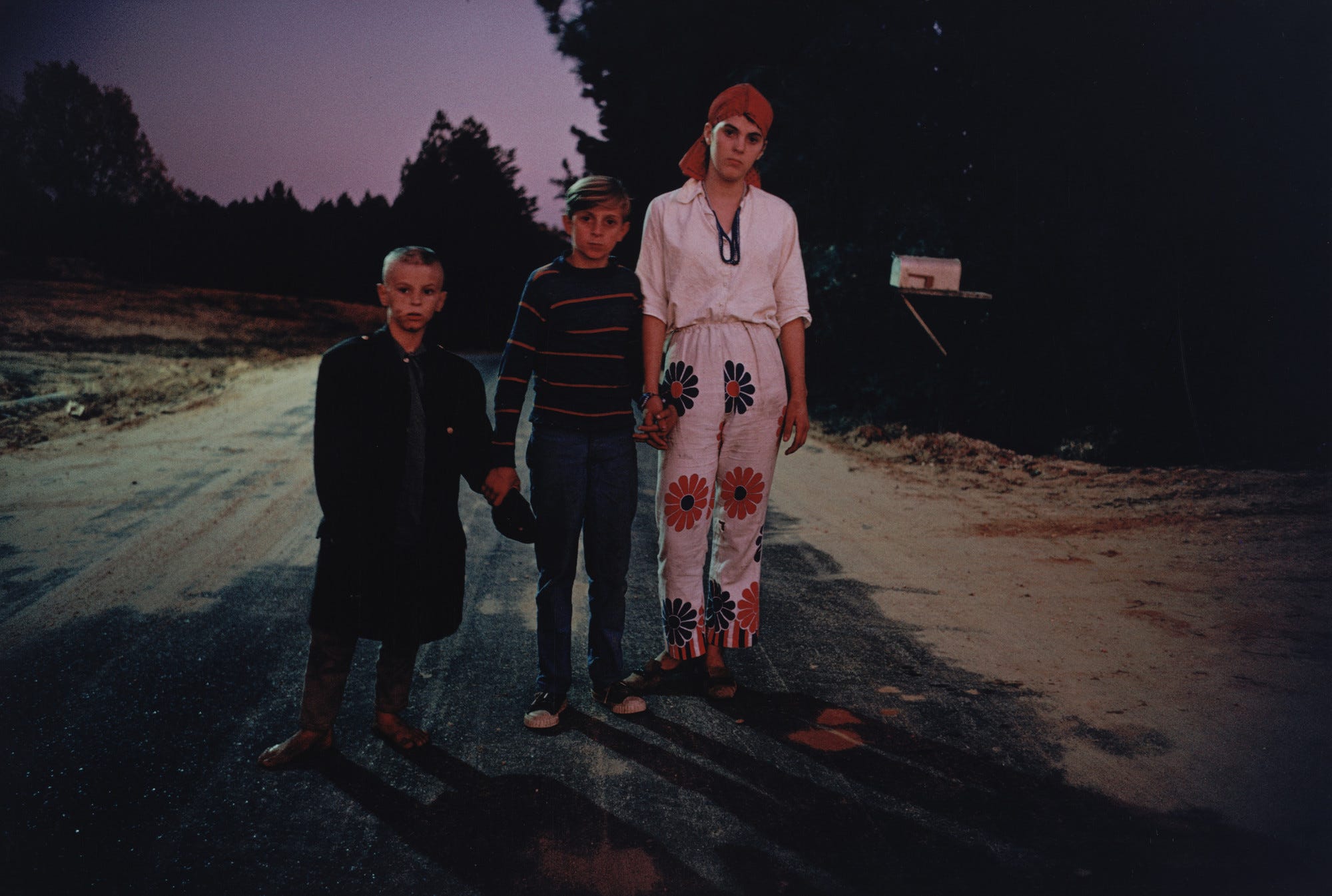
    I leave you with one more set of pixels, one more Egg. Probably taken on the same trip through Morton. This one on the outskirts of town. The same lurid green of the mercury lamp shining on the dirt road behind. The same purple glow in the sky above. It’s Halloween. And as true a picture of the Human Condition as I’ve ever seen. A decisive moment? No. But it’s an image I can’t forget. An image I can barely look at.

  • So here I am, reading The NY Times. About the baffled reaction of NASA scientists to the new photos of the surface of Pluto. Ice Mountains! No craters! Strange cracks on the surface. And then this NASA guy says “we’ll all have to put on our thinking caps.”

    And I begin to wonder about where that phrase – thinking cap – comes from. It seems the term is fairly recent, going back only about 150 years or so. Before then, people called it a “considering cap.”

    Here, for example, is Robert Armin, writing in a 1600 pamphlet, “Foole upon foole”: “The Cobbler puts off his considering cap, why sir, sayes he, I sent them home but now.”

    So it seems a considering cap is a sort of mental metaphor for cobbling your thoughts together. And even more interesting is the notion that once you take this cap off, your thoughts are sent home! Where they came from. As though they live in some space under the cap, lying asleep, waiting to be summoned forth the next day into further consideration.

    So here, 300 years before Freud, we have a curious, primitive forerunner of the idea of a conscious mind (the cap, a crude image of the neocortex) sitting atop an Unconscious Mind, a place where thoughts originate, at home within us, but at rest, as it were.

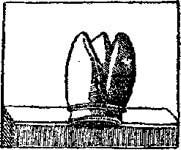
    There’s no evidence I can find that the metaphor was taken literally, and that people actually wore such caps as an aid in helping to bring their thoughts to conscious awareness and assembling them into coherent ideas. But there is a drawing of one!

    From The History of Little Goody Two-Shoes, a children’s story, a variation on Cinderella, published in London in 1765. With this description:

    “…a considering Cap, almost as large as a Grenadier’s, but of three equal Sides;

    on the first of which was written, I MAY BE WRONG;

    on the second, IT IS FIFTY TO ONE BUT YOU ARE ;

    and on the third, I’LL CONSIDER OF IT.”

    So considering involves weighing the possibility that you *might* just be wrong, versus the overwhelming probability that you are right! The basic duel between opposites, disproportionately biased in your favor. However, room is left for a third option: to reflect further on the matter. And indeed, the word “consider” (from the same root for “sidereal”) originally meant to reflect upward, on the heavens, and let your thoughts be with the stars.

    So here we have another kind of cap, that sits above us – a starry world upon which we may project our unconscious thoughts, in somewhat the same manner as ancient civilizations saw archetypal patterns in the stars and named them as constellations, like the Bull or the Scorpion. Consider long enough, and a pattern will make an appearance on the sky of your mind, your considering cap.

    But let’s consider this further. And return to Robert Armin, the fellow who wrote that pamphlet about fools back in 1600. Any idea who he was? I didn’t have a clue. But surprise – it turns out that Armin played a very significant role, quite literally, in our theatrical history. The actor who first performed The Fool in Shakespeare’s King Lear at the Globe Theatre, when it opened on December 26, 1606!

    Mr. Armin was no ordinary fool. It seems he invented the very Idea of the Fool. Or created an entirely new way of performing that character. And maybe a new kind of Performance Art.

    Lower-case “fools” have always been around. Air-heads, from the Latin root for bellows. But sometime in the middle of the Middle Ages (ca. 1275), the meaning shifted to “madman” – as in fou, French for crazy – someone acting outside the strict norms of Christian society that constitute proper, rational behavior. And soon after that, it became a job, a specialty act, the job description requiring foolishness enacted on purpose.

    A Fool or jester (Armin calls him an “artificial” fool) became just a hired hand, a lackey, a deliberately impious rascal, employed in a royal or noble household to provide wit and entertainment, and to flatter his master.

    A good fool was a skilled performer, an artisan who displayed his finely-honed wares in public. Indeed, the best fools often gave solo shows, a kind of spontaneous battle of wits between the Fool and members of the audience, to see who could make a better fool of the other.

    These were jovial social events, in which the community gathered to share a good laugh, jesting and jousting with one another. But Armin’s Foole (he calls him the “natural fool”) offered a whole new take on the matter. Madness became a method. A primitive talking cure. (And by the way, one of the first theaters where Armin performed his new tricks was right next door to Bethlem Hospital, aka Bedlam, the asylum for the insane.)

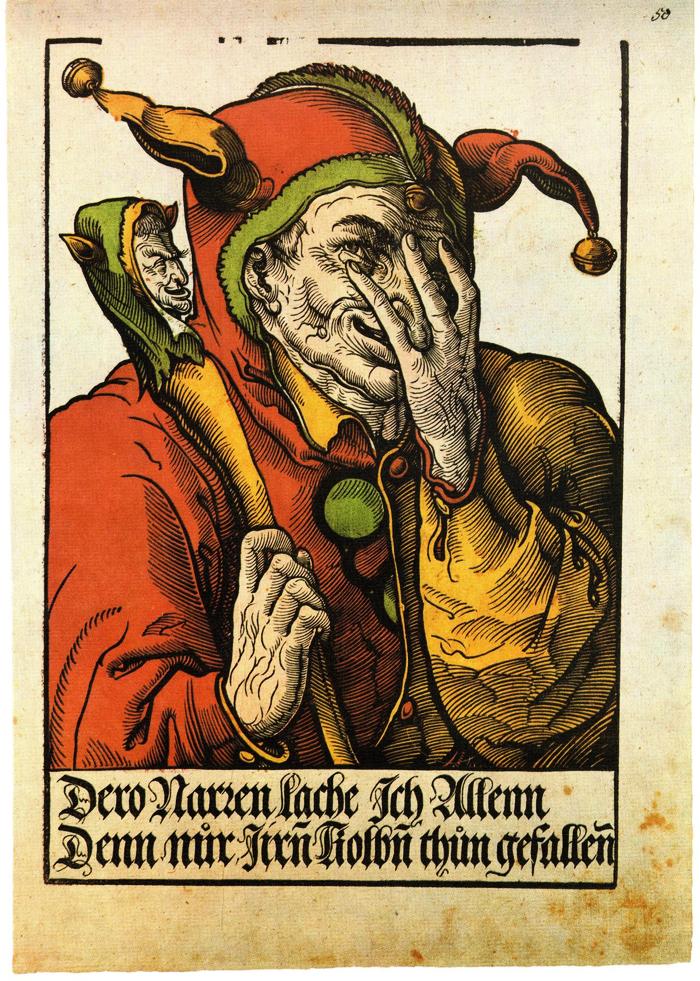
    A painting of a fool, with his marotte — a prop stick, imitating a scepter, an emblem of the king of wit. And carved into the top of it is a miniature portrait of himself. The fool would use his marotte to make comic gestures, rap on the ground to call for attention, point to people and deliver crushing blows of wit upon his opponents. So besides being a parody of royal power, it was also a kind of cudgel.

    But here is where Armin went a step further. He personified his marotte, and named it Sir Truncheon. And talked to it as if it were a real person. And it talked back. Not to the audience, but to Armin himself.

    It became a kind of running dialogue between the two sides of the fool – hence the title of Armin‘s pamphlet: “foole upon foole” – one side pretending to be wise and noble and good, and the other, natural side, who makes fun of the other’s pretensions and foibles. This natural fool no longer flatters and entertains his master. This fool is mad to tell the brutal truth. He no longer swears allegiance to his master, but to Nature. And the audience no longer participates, it watches the unruly drama unfold, between a mind divided against itself.

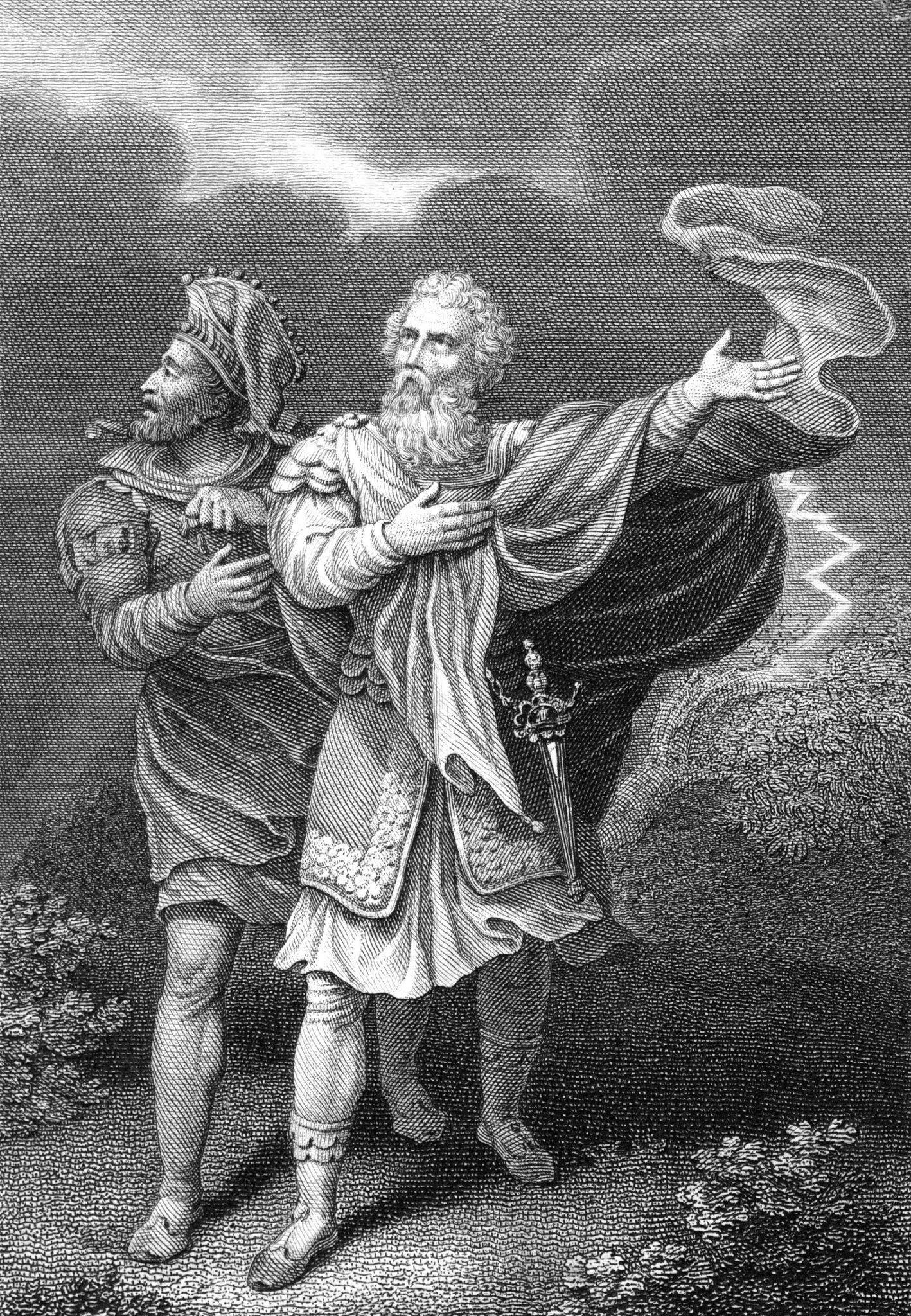
    And there you have King Lear — a noble fool if ever there was — disowned by his own daughters and stripped of his power, he cannot face the brutal truth of his situation, above all, that he has brought it upon himself though his own willful blindness. What is happening to Lear is… unthinkable.

    As the Fool tells him: “I had rather be any kind o’ thing than a fool. And yet I would not be thee, nuncle. Thou hast pared thy wit o’ both sides and left nothing i’ th’ middle.”

    Lear cannot put on his 3-sided thinking cap. He’s lost his wits and cannot tell right from wrong, nor consider anything in between. Three sides, three daughters. Two wicked daughters take him for a fool and divide his kingdom, while the third refuses to flatter her father, and is rejected for her honesty. So it is left to this Natural Fool to speak in riddles and give voice to a harsh wisdom from the depths, telling the king what his conscious mind refuses to hear.

    Three centuries later, Freud tried to reconnect us with our Inner Fool. Our shadow, who still speaks to us in riddles, but only at night, in our dreams, or occasionally in our slips of the tongue, as though another voice were speaking our thoughts, revealing what we honestly meant, but have tried to repress from conscious awareness.

    Is it too much to see Armin’s invention of a new kind of fool – who no longer flatters his master, but challenges him to accept the inadmissible – as a crucial milepost, not only in the evolving lineage of the theater, but in the cultural history of Western consciousness? Is this not a link in a long (and broken) chain, going back to the daimones of Greece, those spirit voices from within, upon whom an ancient Greek could rely as a guide, a pyschopomp, a god-like entity greater than your reasoning mind, an ally who gives you a deeper non-rational connection to your life? And whom Christianity has cast aside, as the voice of the devil. A demon.

    Look closely at the figure of the Fool on the marotte. Does he not look devilish? Those pointy ears, that mischievous grin? The daimon, transformed. Become a Trickster, who plays games with your conscious mind, holding up a mirror, whispering truths in your ear that you must listen to, or suffer the fateful consequences.

    As Jung said, “Until you make the unconscious conscious, it will direct your life and you will call it fate.”

    And now where are we, a century after Freud and Jung? Whenever our mind grows turbulent, our thinking caps impaired, our bearings lost, what are we to do? Take a pill!

    And if the problem persists, then pills become meds. And the voices within are silenced, considered only as signs of a foolish madness.